The Davenporter
Essays Code Arcade Now
Theme
Palette
Jason Davenport

I write about agents doing real engineering work: source control, memory, telemetry, and the human side of AI.

Subscribe

Elsewhere

  • Substack
  • LinkedIn
  • GitHub
  • X
  • RSS
  1. Home
  2. Essays
  3. AI and the New Business Moat: Defending Your Competitive Advantage

AI and the New Business Moat: Defending Your Competitive Advantage

May 19, 2026 · 5 min read · Original on Substack ↗

AI requires you to create another moat of advantage. Here are my thoughts about how to do it. I’m fortunate enough each year to lead a number of Google engineers as we build our keynotes. These activities take a lot of time.

Cover image for AI and the New Business Moat: Defending Your Competitive Advantage
Cover image from the original post.

I’m fortunate enough each year to lead a number of Google engineers as we build our our keynotes. These activities take a lot of time. We typically start in December on our big launches and themes, then hit the ground running in January when we define our creative canvas, and build out each of the demos. Along the way, we usually discover a lot of things (shocker). One thing that stood out to me this year in a technical, but non-technical way is how much generalized knowledge LLMs now have to answer most questions I would have outsourced, at least to some cursory level. This represents a new challenge to organizations: if AI can do the work, what are the advantages you have?

How AI is challenging your moat
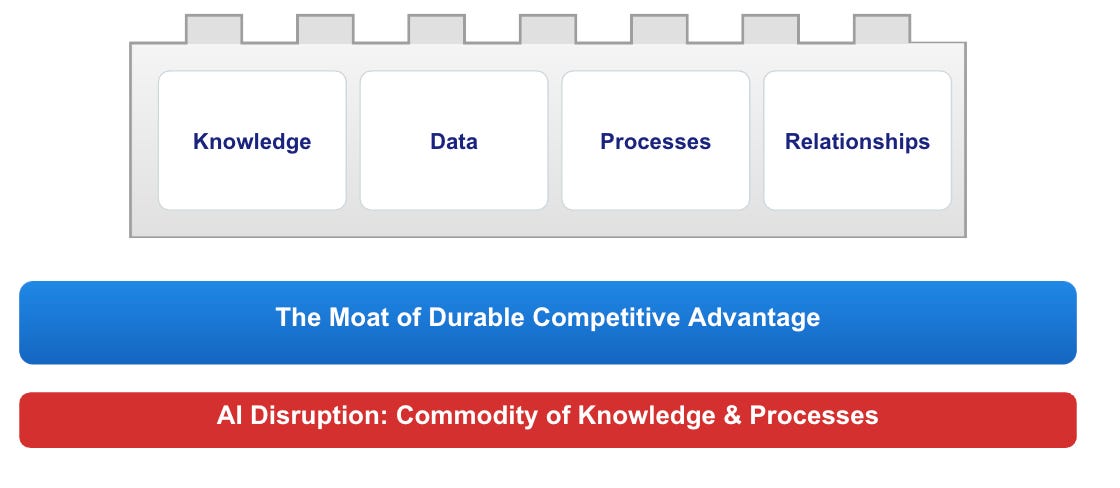
Depiction of the things that provide advantages to a company, and how AI is a disruptor

In business school, we often talk about the competitive advantages of a company. The moat becomes the durable patterns that sustain a company’s advantages.

In the software world, patterns might be the data advantage you have (see my prior article), the durable relationship you’ve built with your customers that no one else can do, or the fact that a switching cost is too high (although switching costs are less of a ‘desired advantage’ than a threat to the customer of change).

AI presents a new challenge to the durability of your moat, but sometimes not in ways you’d expect. I’ll present a tangible example I’ve recently experienced, and then talk about how you can better position yourself and your company to defend against this new competitor.

An example: the cost of landscape design

We have a rental property pretty close to our house. The front yard is massive, its covered in grass, and gets almost zero shade during the hot Colorado summers. This, in combination with the severe drought, presents a number of challenges (both in terms of the actual cost of water and the philosophical question of being environmentally responsible).

So I presented a picture of this yard to Gemini, and asked it to xeriscape based on the location the house is at, the size of the yard, and my requirements (very low water usage and maintenance).

And, unsurprisingly, the list of recommendations including an image of what this looked like are pretty decent!

In this example, why would I use a landscaping company then? I’d have to pay for the architect time, and then probably overpay for doing the work (I’m pretty handy and I like doing this type of work myself). AI did a ‘C’ job, which for this example translates to ‘good enough’.

The challenge to the existing landscape design and contracting firms

In the above, it’s clear I have some process expertise and I was able to leverage generalized knowledge, and multimodality in a model. I’m probably not the average customer. I used AI to reduce the knowledge and process component of the moat.

But how many of these examples exist that start to erode the moat?

For the landscape architecture firm, the firm must seek to shift and deepen the moat around expertise and design. This can include moving up in the desired customer base and focus, or using AI as a design partner in the flow to accelerate the process with customers to get their yards re-landscaped. This could also include capturing more data for things like water use or design traits that people really like.

Alternatively, a company could choose to double down on the execution side. While I know how to do the work, it’s also highly time intensive and not complex labor. Scaling the advantage of execution may be preferable to some.

All of these changes are valid approaches, but require ‘moving the moat’ from a customer perspective.

Tangible steps to defend your moat from AI

For any company, AI presents both advantages and threats (we probably should add this to a SWOT or Porter’s 5 Forces box). What are some things I’m thinking about to help strengthen the moat?

Here are a few things I’ve found along the way that are tactical steps you can take this week to start understanding the potential impact of AI, and what to start hardening.

  1. Pay for AI. Even a cheap subscription limits the amount of information that could leak from seemingly innocent questions. This is a basic but required step to protecting your intellectual property.

  2. Ask AI what it knows. In the example of Google Cloud Next, we used AI to help us build a skill about planning a marathon (most of us knew comparatively little about the actual event planning process). Someone on our team had worked as a coordinator before and helped validate the steps. The latest models were surprisingly close to understanding the full process. Do this in a paid account to see how much you think is your ‘secret sauce’ vs. generalized knowledge in a model.

  3. Identify your data and process advantages AI doesn’t have. You should assume that as LLMs continue to improve, the 'distinct’ advantages you have will continue to erode. Your first party information (data, processes, relationships), becomes even more valuable in this world. Build around the things only you can do.

  4. Leverage AI to harden your advantages. If you know how to prompt AI, the rate which you’ll be able to move is probably 2-10x someone else. Take training on AI skills even if you own a small business. In the landscaping example, if you can use AI to even get to a draft faster, this represents ways you can build new advantages in your relationships with your customers.

  5. Understand the AI limiting tools at your fingertips. Most people dont think about robots.txt for internet scraping. There are new methods to help prevent your public knowledge from being used to train models. Consider what these mean, but also if your competitors allow scraping, what you should tangibly protect from training vs. what enables you to be a ‘trusted’ provider in GEO (generative engine optimization aka being a grounded link in something like a prompt response).

Please let me know what else you’re thinking about with AI and your organizations! Happy Tuesday!

Thanks for reading The Davenporter! Subscribe for free to receive new posts and support my work.

← Newer essay What I'm building this week(/month/quarter) Older essay → 'Dark data' is your new most valuable data for AI

Get new posts by email

I send new essays by email through Substack. Subscribe there and they'll land in your inbox.

Subscribe on Substack ↗
Subscribe on Substack · RSS · Privacy ·
Page metadata

Social card and structured data

The share image, feeds and Schema.org JSON-LD that search engines and AI tools read for this page.

Social card

Title card for AI and the New Business Moat: Defending Your Competitive Advantage
Card URL: /og/ai-and-the-new-business-moat-defending.svg

Machine feeds

/llms.txt /llms-full.txt /sitemap.xml /api/agent/spec

Structured data

{
  "@context": "https://schema.org",
  "@graph": [
    {
      "@type": "Person",
      "@id": "https://davenporter.com/#jason-davenport",
      "name": "Jason Davenport",
      "alternateName": "@davenportjw",
      "jobTitle": "AI & Distributed Systems Architect",
      "description": "Exploring agent-first source control (cosm), trajectory-to-lineage observability, Spanner-backed agent memory consolidation (Electric Sheep), hybrid local/cloud LLM routing, and real-time multiplayer browser simulations on Google Cloud Run.",
      "url": "https://davenporter.com",
      "sameAs": [
        "https://davenporter.substack.com",
        "https://www.linkedin.com/in/davenportjw",
        "https://github.com/davenportjw",
        "https://x.com/davenportjw"
      ]
    },
    {
      "@type": "WebSite",
      "@id": "https://davenporter.com/#website",
      "url": "https://davenporter.com",
      "name": "The Davenporter",
      "description": "Learnings about software, technology, agentic systems, and occasionally home renovation.",
      "publisher": {
        "@id": "https://davenporter.com/#jason-davenport"
      },
      "inLanguage": "en-US"
    },
    {
      "@type": "ImageObject",
      "@id": "https://davenporter.com/writings/ai-and-the-new-business-moat-defending#primaryimage",
      "url": "https://davenporter.com/og/ai-and-the-new-business-moat-defending.png",
      "contentUrl": "https://davenporter.com/og/ai-and-the-new-business-moat-defending.png",
      "width": 1200,
      "height": 630,
      "caption": "Title card for AI and the New Business Moat: Defending Your Competitive Advantage",
      "representativeOfPage": true,
      "creator": {
        "@id": "https://davenporter.com/#jason-davenport"
      },
      "license": "https://creativecommons.org/licenses/by/4.0/",
      "acquireLicensePage": "https://davenporter.com/writings"
    },
    {
      "@type": "WebPage",
      "@id": "https://davenporter.com/writings/ai-and-the-new-business-moat-defending#webpage",
      "url": "https://davenporter.substack.com/p/ai-and-the-new-business-moat-defending",
      "name": "AI and the New Business Moat: Defending Your Competitive Advantage | The Davenporter",
      "description": "AI requires you to create another moat of advantage. Here are my thoughts about how to do it. I\u2019m fortunate enough each year to lead a number of Google engineers as we build our keynotes. These activities take a lot of time.",
      "isPartOf": {
        "@id": "https://davenporter.com/#website"
      },
      "about": {
        "@id": "https://davenporter.com/#jason-davenport"
      },
      "primaryImageOfPage": {
        "@id": "https://davenporter.com/writings/ai-and-the-new-business-moat-defending#primaryimage"
      },
      "inLanguage": "en-US"
    },
    {
      "@type": "FAQPage",
      "@id": "https://davenporter.com/writings/ai-and-the-new-business-moat-defending#faq",
      "mainEntity": [
        {
          "@type": "Question",
          "name": "What is \u201cAI and the New Business Moat: Defending Your Competitive Advantage\u201d about?",
          "acceptedAnswer": {
            "@type": "Answer",
            "text": "AI requires you to create another moat of advantage. Here are my thoughts about how to do it. I\u2019m fortunate enough each year to lead a number of Google engineers as we build our keynotes. These activities take a lot of time."
          }
        }
      ]
    },
    {
      "@type": "BlogPosting",
      "@id": "https://davenporter.com/writings/ai-and-the-new-business-moat-defending#article",
      "mainEntityOfPage": {
        "@id": "https://davenporter.com/writings/ai-and-the-new-business-moat-defending#webpage",
        "url": "https://davenporter.substack.com/p/ai-and-the-new-business-moat-defending"
      },
      "headline": "AI and the New Business Moat: Defending Your Competitive Advantage",
      "alternativeHeadline": "AI requires you to create another moat of advantage. Here are my thoughts about how to do it.",
      "description": "AI requires you to create another moat of advantage. Here are my thoughts about how to do it. I\u2019m fortunate enough each year to lead a number of Google engineers as we build our keynotes. These activities take a lot of time.",
      "datePublished": "2026-05-19T16:01:24Z",
      "dateModified": "2026-05-19T16:01:24Z",
      "wordCount": 1036,
      "keywords": "Source Control, AI Strategy",
      "author": {
        "@id": "https://davenporter.com/#jason-davenport"
      },
      "publisher": {
        "@id": "https://davenporter.com/#jason-davenport"
      },
      "image": {
        "@id": "https://davenporter.com/writings/ai-and-the-new-business-moat-defending#primaryimage"
      },
      "url": "https://davenporter.substack.com/p/ai-and-the-new-business-moat-defending"
    },
    {
      "@type": "BreadcrumbList",
      "@id": "https://davenporter.com/writings/ai-and-the-new-business-moat-defending#breadcrumb",
      "itemListElement": [
        {
          "@type": "ListItem",
          "position": 1,
          "name": "Home",
          "item": "https://davenporter.com/"
        },
        {
          "@type": "ListItem",
          "position": 2,
          "name": "Essays",
          "item": "https://davenporter.com/writings"
        },
        {
          "@type": "ListItem",
          "position": 3,
          "name": "AI and the New Business Moat: Defending Your Competitive Advantage",
          "item": "https://davenporter.com/writings/ai-and-the-new-business-moat-defending"
        }
      ]
    }
  ]
}

Ask The Davenporter

● Checking local AI… How it works →

Chrome can download Gemini Nano so answers run on your device.

0%
Ask anything about the essays, projects, or games on this site.