The Davenporter
Essays Builds Now About
Theme
Palette
Jason Davenport

I write about agents doing real engineering work: source control, memory, telemetry, and the human side of AI.

Subscribe

Elsewhere

  • About me
  • Workbench notes
  • Substack
  • Medium
  • LinkedIn
  • GitHub
  • X
  • RSS
Workbench

Notes

I keep short workbench notes here between full essays: benchmark scorecards, before and after diffs, and two-branch routing diagrams from real agent builds, each paired with a plain takeaway you can test on your own traffic.

Full essays Workbench notes
All Scorecard Before / After Mental model
  1. Nov 17, 2026
    Mental model Agent Engineering · Developer Workflow
    #

    Two coding agents, two worktrees: Floor Trials goes from 6 to 18 challenges, plus ghost runs

    Takeaway

    Split parallel agent work by file ownership, tell each agent what the other one owns, and make every branch prove itself (bit-for-bit replays, a bot that clears each level) before merge.
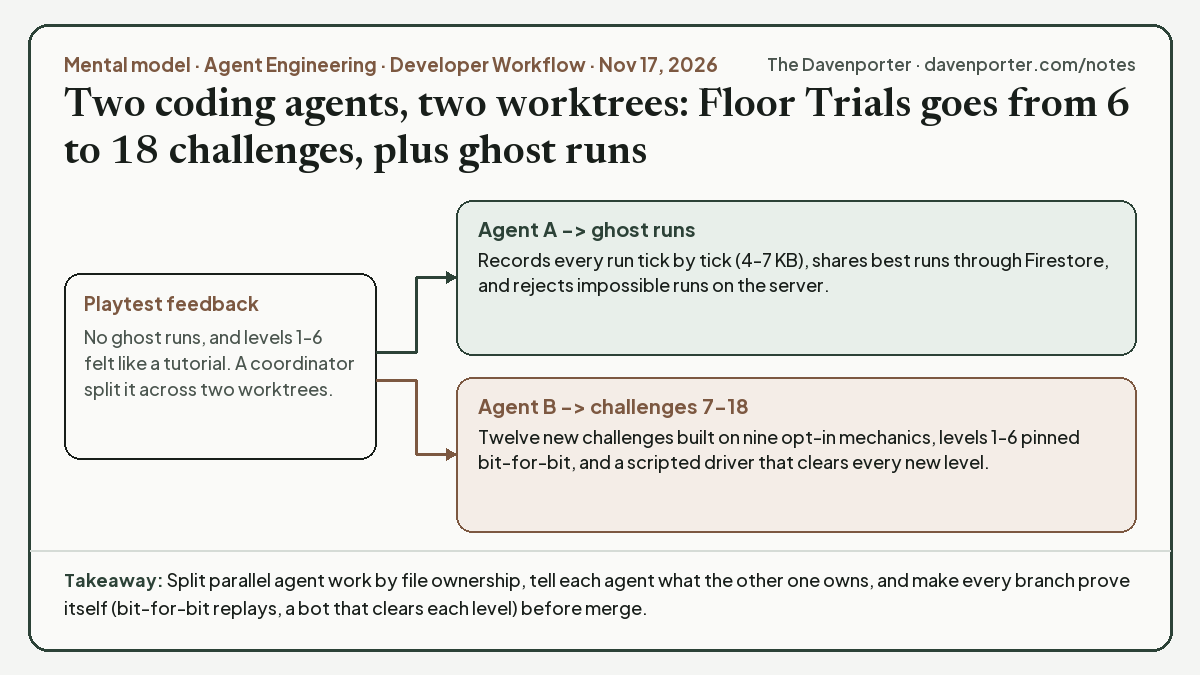
    Two-branch diagram: a playtest splits into one agent building ghost runs and another building challenges 7 to 18 (taking Floor Trials from 6 to 18), each on its own branch.
    Two-branch diagram: a playtest splits into one agent building ghost runs and another building challenges 7 to 18 (taking Floor Trials from 6 to 18), each on its own branch.
    Read context and raw numbers

    A playtest of Floor Trials turned into two parallel agent branches that merged in about 40 minutes, because each branch had to prove itself before merge.

    Playtest: no ghosts, and levels 1-6 felt like a tutorial A coordinator agent read the code first (ghost runs had never been built), then split the work into two branches in separate worktrees, with each brief naming the files the other agent owned.

    Agent A -> ghost runs - Records position, heading, fork height, stack, and sway every tick (about 4 KB for a 72-second run, 7 KB for the largest) - Shares each player's best run per level through Firestore - Server rejects impossible runs (a faked run came back 422 too_fast)

    Agent B -> challenges 7-18 - Twelve new challenges (taking Floor Trials from 6 to 18) built on nine opt-in mechanics: putaway, cross-dock, glass, heavy loads, cones, battery, dock windows, traffic, and lights out - Levels 1-6 pinned with bit-for-bit regression fingerprints - A scripted driver clears every new level without a strike

    Nobody has cleared challenges 7-18 on the live board yet, so difficulty is still a guess from a test driver.
    Full essay: FreightFloor two weeks in: the bill, the wobble, and the cab view → Build: Freight Floor → LinkedIn ↗ X ↗
  2. Nov 08, 2026
    Mental model Agent Engineering · Developer Workflow
    #

    When to give a coding agent an AST graph vs. plain ripgrep

    Takeaway

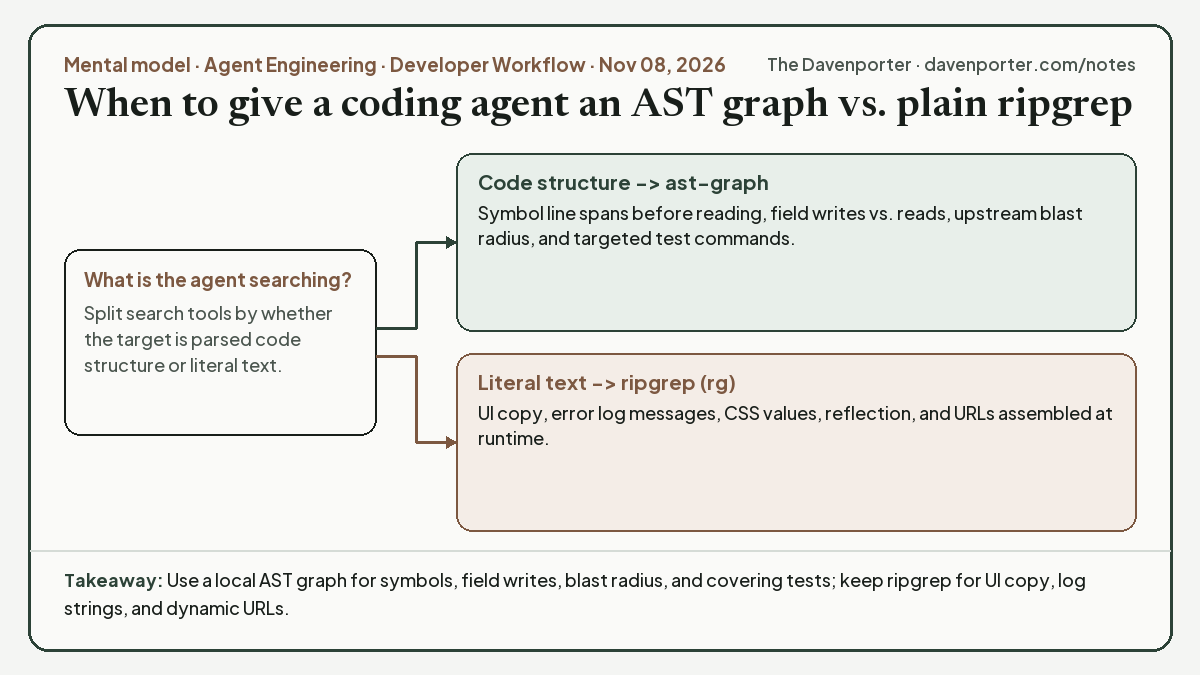
    Use a local AST graph for symbols, field writes, blast radius, and covering tests; keep ripgrep for UI copy, log strings, and dynamic URLs.

    Parallel two-branch diagram splitting agent code search between ast-graph for parsed structure and ripgrep for literal strings.
    Parallel two-branch diagram splitting agent code search between ast-graph for parsed structure and ripgrep for literal strings.
    Read context and raw numbers

    Static symbol indexing cuts 70% to 90% of structural search tokens across my sessions, while rg remains the right tool whenever the target is a raw string rather than a symbol.

    What is the agent searching? Split search tools by whether the target is parsed code structure or literal text.

    Code structure -> ast-graph - Exact file#Lstart-Lend spans before reading a 3,000-line file - Property writes separated from reads for state bugs - Upstream blast radius and targeted test commands

    Literal text -> ripgrep (rg) - UI copy, error messages, and CSS values - Dynamic imports, reflection, and URLs built at runtime

    Full essay: Your coding agent is reading too much code → Build: ast-graph →
From workbench note to full essay

Scroll →

How daily workbench notes graduate into canonical essays Real benchmark tables, prompt diffs, and routing splits start as short workbench notes, get shared on LinkedIn and X, and the questions that spark discussion become full essays. 1. Capture • Benchmark scorecards • Before / after diffs • Routing mental models 2. Share nugget Timeline + native cards • Published at /notes • Native PNG on X & LI 3. Graduate Full canonical essay /notes.md · /api/notes /writings/{slug}
Short workbench artifacts land here first (and as Markdown at /notes.md or JSON at /api/notes); the notes that spark real engineering questions graduate into full essays.
Workbench notes index, newest first
Date Format Note Takeaway
Nov 18, 2026 Scorecard Gemini followed my UI skills and Opus skipped them: deleting 95% of my agent rules Guardrails written for older models poison newer ones that actually follow them: cutting 95% of my agent config (222.3 KB to 11.4 KB) fixed my UI builds.
Nov 17, 2026 Mental model Two coding agents, two worktrees: Floor Trials goes from 6 to 18 challenges, plus ghost runs Split parallel agent work by file ownership, tell each agent what the other one owns, and make every branch prove itself (bit-for-bit replays, a bot that clears each level) before merge.
Nov 10, 2026 Before / After Stop paying a generative model to print JSON just to pick another model Swapping a rubric-and-JSON classifier prompt for a single forward-pass decision call cut routing latency 3.5x (752 ms to 212 ms) with zero output tokens.
Nov 08, 2026 Mental model When to give a coding agent an AST graph vs. plain ripgrep Use a local AST graph for symbols, field writes, blast radius, and covering tests; keep ripgrep for UI copy, log strings, and dynamic URLs.
Nov 06, 2026 Scorecard One schema change on a 161-file TypeScript monorepo: grep vs. ast-graph Query an AST symbol graph before opening files so source maps and 3,000-line modules never land in your agent's context window.
About · Notes · Subscribe on Substack · RSS · Privacy ·
Ask

Social card and structured data

The share image, feeds and Schema.org JSON-LD that search engines and AI tools read for this page.

Social card

Title card for Notes
Card URL: /og/notes.svg

Machine feeds

/llms.txt /llms-full.txt /sitemap.xml /api/agent/spec

Structured data

{
  "@context": "https://schema.org",
  "@graph": [
    {
      "@type": "Person",
      "@id": "https://davenporter.com/#jason-davenport",
      "name": "Jason Davenport",
      "alternateName": "@davenportjw",
      "jobTitle": "AI & Distributed Systems Architect",
      "description": "Exploring agent-first source control (cosm), trajectory-to-lineage observability, Spanner-backed agent memory consolidation (Electric Sheep), hybrid local/cloud LLM routing, and real-time multiplayer browser simulations on Google Cloud Run.",
      "url": "https://davenporter.com",
      "sameAs": [
        "https://davenporter.substack.com",
        "https://www.linkedin.com/in/davenportjw",
        "https://github.com/davenportjw",
        "https://x.com/davenportjw",
        "https://medium.com/@davenportjw"
      ]
    },
    {
      "@type": "WebSite",
      "@id": "https://davenporter.com/#website",
      "url": "https://davenporter.com",
      "name": "The Davenporter",
      "description": "Learnings about software, technology, agentic systems, and occasionally home renovation.",
      "publisher": {
        "@id": "https://davenporter.com/#jason-davenport"
      },
      "inLanguage": "en-US"
    },
    {
      "@type": "ImageObject",
      "@id": "https://davenporter.com/notes#primaryimage",
      "url": "https://davenporter.com/og/notes.png",
      "contentUrl": "https://davenporter.com/og/notes.png",
      "width": 1200,
      "height": 630,
      "caption": "Title card for Notes",
      "representativeOfPage": true,
      "creator": {
        "@id": "https://davenporter.com/#jason-davenport"
      },
      "license": "https://creativecommons.org/licenses/by/4.0/",
      "acquireLicensePage": "https://davenporter.com/writings"
    },
    {
      "@type": "CollectionPage",
      "@id": "https://davenporter.com/notes#webpage",
      "url": "https://davenporter.com/notes",
      "name": "Notes | The Davenporter",
      "description": "I keep short workbench notes here between full essays: benchmark scorecards, before and after diffs, and two-branch routing diagrams from real agent builds, each paired with a plain takeaway you can test on your own traffic.",
      "isPartOf": {
        "@id": "https://davenporter.com/#website"
      },
      "about": {
        "@id": "https://davenporter.com/#jason-davenport"
      },
      "primaryImageOfPage": {
        "@id": "https://davenporter.com/notes#primaryimage"
      },
      "inLanguage": "en-US"
    },
    {
      "@type": "FAQPage",
      "@id": "https://davenporter.com/notes#faq",
      "mainEntity": [
        {
          "@type": "Question",
          "name": "What short workbench notes and benchmarks has Jason Davenport shared recently?",
          "acceptedAnswer": {
            "@type": "Answer",
            "text": "I keep short workbench notes here between full essays: benchmark scorecards, before and after diffs, and two-branch routing diagrams from real agent builds, each paired with a plain takeaway you can test on your own traffic."
          }
        }
      ]
    },
    {
      "@type": "BreadcrumbList",
      "@id": "https://davenporter.com/notes#breadcrumb",
      "itemListElement": [
        {
          "@type": "ListItem",
          "position": 1,
          "name": "Home",
          "item": "https://davenporter.com/"
        },
        {
          "@type": "ListItem",
          "position": 2,
          "name": "Notes",
          "item": "https://davenporter.com/notes"
        }
      ]
    }
  ]
}

Ask The Davenporter

Ask anything about the essays and builds on this site.