The Davenporter
Essays Builds Now About
Theme
Palette
Jason Davenport

I write about agents doing real engineering work: source control, memory, telemetry, and the human side of AI.

Subscribe

Elsewhere

  • About me
  • Workbench notes
  • Substack
  • Medium
  • LinkedIn
  • GitHub
  • X
  • RSS
Workbench

Notes

I keep short workbench notes here between full essays: benchmark scorecards, before and after diffs, and two-branch routing diagrams from real agent builds, each paired with a plain takeaway you can test on your own traffic.

Full essays Workbench notes
All Scorecard Before / After Mental model
  1. Nov 18, 2026
    Scorecard Agent Engineering · Developer Workflow
    #

    Gemini followed my UI skills and Opus skipped them: deleting 95% of my agent rules

    Takeaway

    Guardrails written for older models poison newer ones that actually follow them: cutting 95% of my agent config (222.3 KB to 11.4 KB) fixed my UI builds.
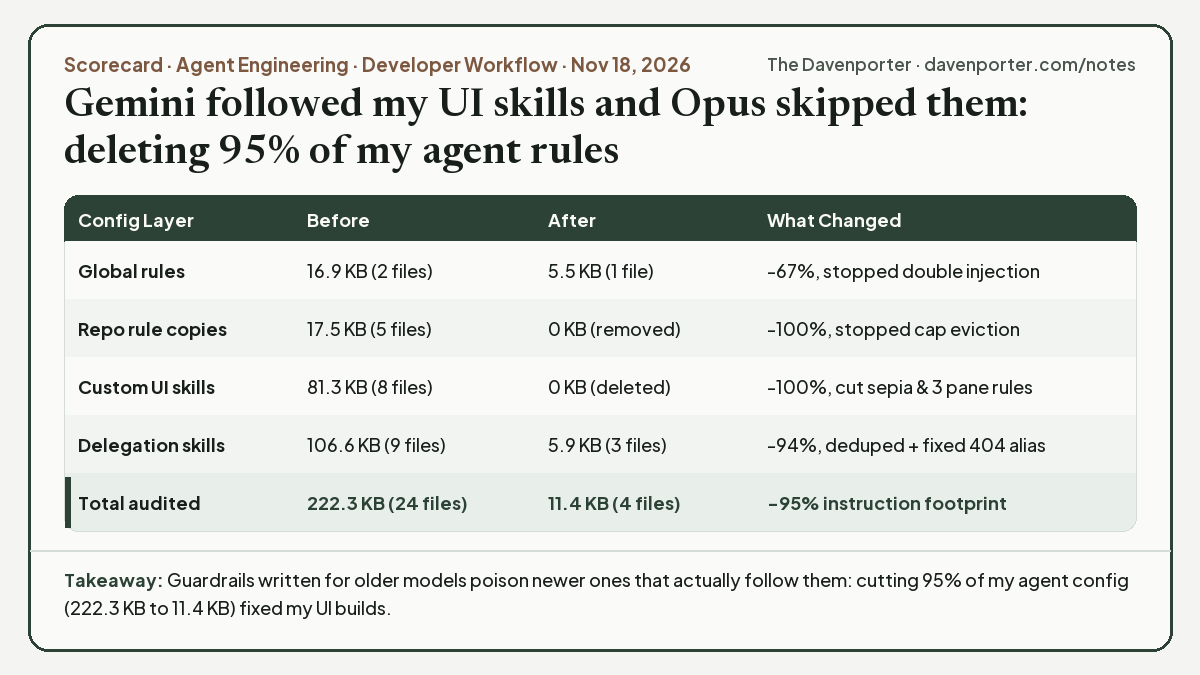
    Scorecard showing agent rules and UI skills cut 95% from 222.3 KB (24 files) to 11.4 KB (4 files).
    Scorecard showing agent rules and UI skills cut 95% from 222.3 KB (24 files) to 11.4 KB (4 files).
    Read context and raw numbers

    I realized Gemini wasn't making good UI, so I dug in, and it turned out my skills were giving it bad advice. They were written for a prior generation of model that struggled with following the plot.

    When I tell my coding agent to build UI's 'similar to Google Workspace', it keeps the UI tight and unnecessary wording to a minimum. Ask for any other type of page, though, and random elements get strewn all over.

    I wanted to know why. Last night I pointed my agent at 528 local transcripts and all my personal repos (45 recent runs, including 19 Claude Opus sessions). That check showed the flip side of last week's ast-graph audit.

    In its best UI sessions, Opus opened zero of my custom UI skills. It used clean hierarchy: one primary action, 1 to 2 word labels, and plain English intent.

    Why was Opus at zero? Rules in GEMINI and AGENTS load in full on turn 1. Skills only appear as a 1 line menu description that costs an extra read_file call to open. Just like lazy MCP schemas last week, Opus skips that menu unless AGENTS names a skill path, and goes straight to the repo code. Gemini scans the menu on turn 1 and opens every match (86 skill reads vs. 7 for Opus on this laptop).

    So Gemini read and obeyed the global and copied repo UI skills I wrote months ago for smaller Flash models (and I put every one of those files there myself). Those files forced a 2 to 3 panel layout, sepia styling, and full metadata dumps. Ask for a simple login or product page and Gemini built a brown 3 column ops dashboard covered in static 'confetti pills'. Buttons got named 'lock failure bundle' instead of 'Save test fixture'. One newer repo even had a local override begging agents not to restyle toward sepia despite my global UI rule.

    Scanning the rest of my repos turned up quieter bloat. Duplicate GEMINI and AGENTS files burned 34.4 KB per turn, pushing real repo architecture rules past the prompt cap and silently evicting them. Nothing threw an error. Three older repos also held 18 KB delegation tables with a retired model alias, so every subagent call failed with a 404.

    Config LayerBeforeAfterWhat Changed
    Global rules16.9 KB (2 files)5.5 KB (1 file)-67%, stopped double injection
    Repo rule copies17.5 KB (5 files)0 KB (removed)-100%, stopped cap eviction
    Custom UI skills81.3 KB (8 files)0 KB (deleted)-100%, cut sepia & 3 pane rules
    Delegation skills106.6 KB (9 files)5.9 KB (3 files)-94%, deduped + fixed 404 alias
    Total audited222.3 KB (24 files)11.4 KB (4 files)-95% instruction footprint

    What remained in that 11.4 KB is 4 files, plus one AGENTS file per repo, with any preconditioning on visual style removed: - One 5.5 KB global rule file covering git worktree isolation and basic UX checks (1 to 2 word labels, UI tests, and checking the rendered screen), loaded on turn 1 so both Opus and Gemini see it. - Three small skills (5.9 KB total) for subagent routing, blind diff review, and one repo's memory, with all 8 custom UI skills deleted.

    Rebuilding a 10 ft projector UI right after the cleanup showed the same habit is still live. Gemini opened a built in web guidance skill on step 1 (0 opens from Opus). It built desktop dropdowns until I reminded it a projector isn't a desktop browser. Put universal defaults in AGENTS so Opus sees them. Scope skill descriptions tightly because Gemini will read them. You will probably delete more than you add.
    Full essay: Same harness, same rules, different habits: Opus vs. Argon in Antigravity → LinkedIn ↗ X ↗
  2. Nov 17, 2026
    Mental model Agent Engineering · Developer Workflow
    #

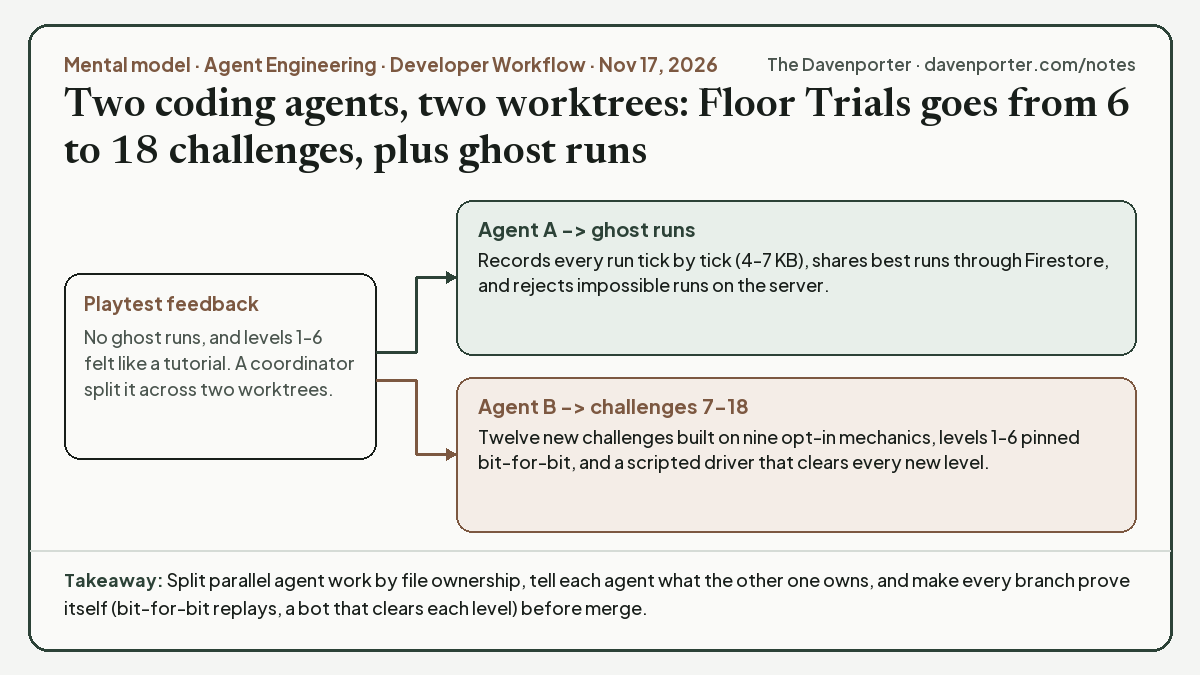
    Two coding agents, two worktrees: Floor Trials goes from 6 to 18 challenges, plus ghost runs

    Takeaway

    Split parallel agent work by file ownership, tell each agent what the other one owns, and make every branch prove itself (bit-for-bit replays, a bot that clears each level) before merge.

    Two-branch diagram: a playtest splits into one agent building ghost runs and another building challenges 7 to 18 (taking Floor Trials from 6 to 18), each on its own branch.
    Two-branch diagram: a playtest splits into one agent building ghost runs and another building challenges 7 to 18 (taking Floor Trials from 6 to 18), each on its own branch.
    Read context and raw numbers

    A playtest of Floor Trials turned into two parallel agent branches that merged in about 40 minutes, because each branch had to prove itself before merge.

    Playtest: no ghosts, and levels 1-6 felt like a tutorial A coordinator agent read the code first (ghost runs had never been built), then split the work into two branches in separate worktrees, with each brief naming the files the other agent owned.

    Agent A -> ghost runs - Records position, heading, fork height, stack, and sway every tick (about 4 KB for a 72-second run, 7 KB for the largest) - Shares each player's best run per level through Firestore - Server rejects impossible runs (a faked run came back 422 too_fast)

    Agent B -> challenges 7-18 - Twelve new challenges (taking Floor Trials from 6 to 18) built on nine opt-in mechanics: putaway, cross-dock, glass, heavy loads, cones, battery, dock windows, traffic, and lights out - Levels 1-6 pinned with bit-for-bit regression fingerprints - A scripted driver clears every new level without a strike

    Nobody has cleared challenges 7-18 on the live board yet, so difficulty is still a guess from a test driver.

    Full essay: FreightFloor two weeks in: the bill, the wobble, and the cab view → Build: Freight Floor → LinkedIn ↗ X ↗
  3. Nov 10, 2026
    Before / After Model Routing · Cloud Cost
    #

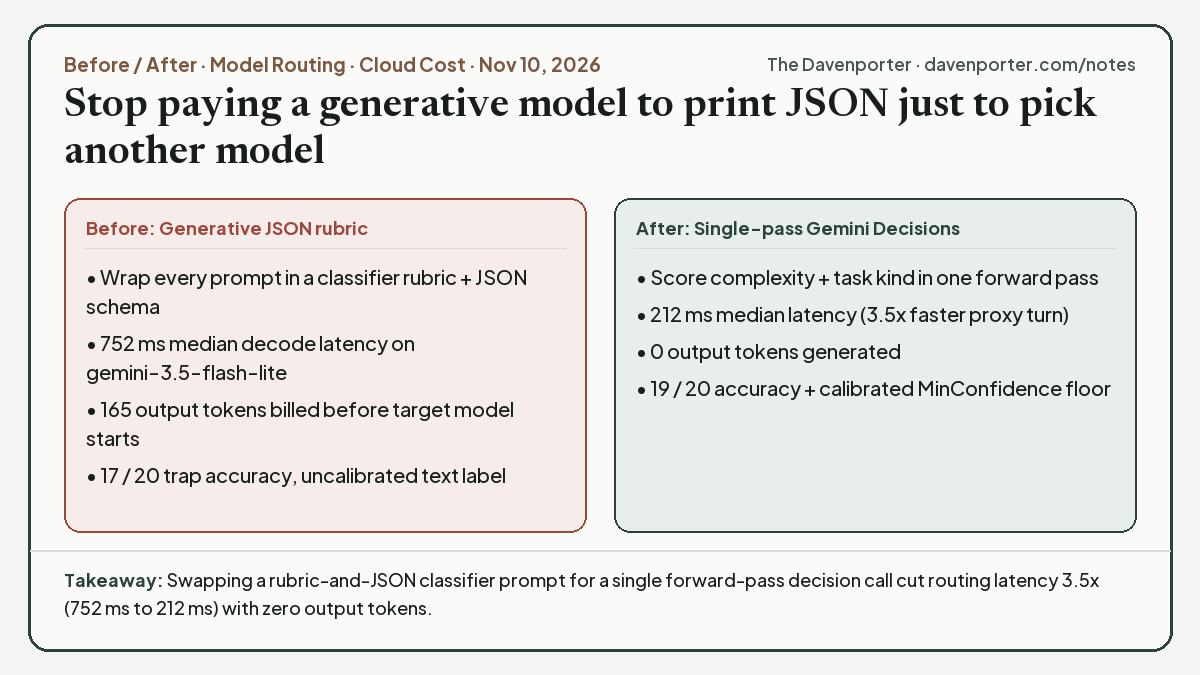
    Stop paying a generative model to print JSON just to pick another model

    Takeaway

    Swapping a rubric-and-JSON classifier prompt for a single forward-pass decision call cut routing latency 3.5x (752 ms to 212 ms) with zero output tokens.

    Before and after comparison showing generative JSON routing at 752 ms and 165 output tokens versus single-pass Gemini Decisions at 212 ms and 0 output tokens.
    Before and after comparison showing generative JSON routing at 752 ms and 165 output tokens versus single-pass Gemini Decisions at 212 ms and 0 output tokens.
    Read context and raw numbers

    In Smart Router, asking a small generative model to emit JSON before the real model ran added decode latency and output token tax on every request.

    Before: Generative JSON rubric - Wrap every user request in a classification rubric and JSON responseSchema - 752 ms median latency waiting on autoregressive token decode - 165 output tokens billed per turn with an uncalibrated string label (17 / 20 on trap suite)

    After: Single-pass Gemini Decisions - Score complexity and task kind in one forward pass (gemini-decision-1) - 212 ms median latency (3.5x faster) and 0 output tokens - Calibrated probabilities (19 / 20) with a real MinConfidence escalation floor

    Full essay: Stop generating JSON just to pick a model: semantic routing with Gemini Decisions → Build: SmartRouter →
  4. Nov 08, 2026
    Mental model Agent Engineering · Developer Workflow
    #

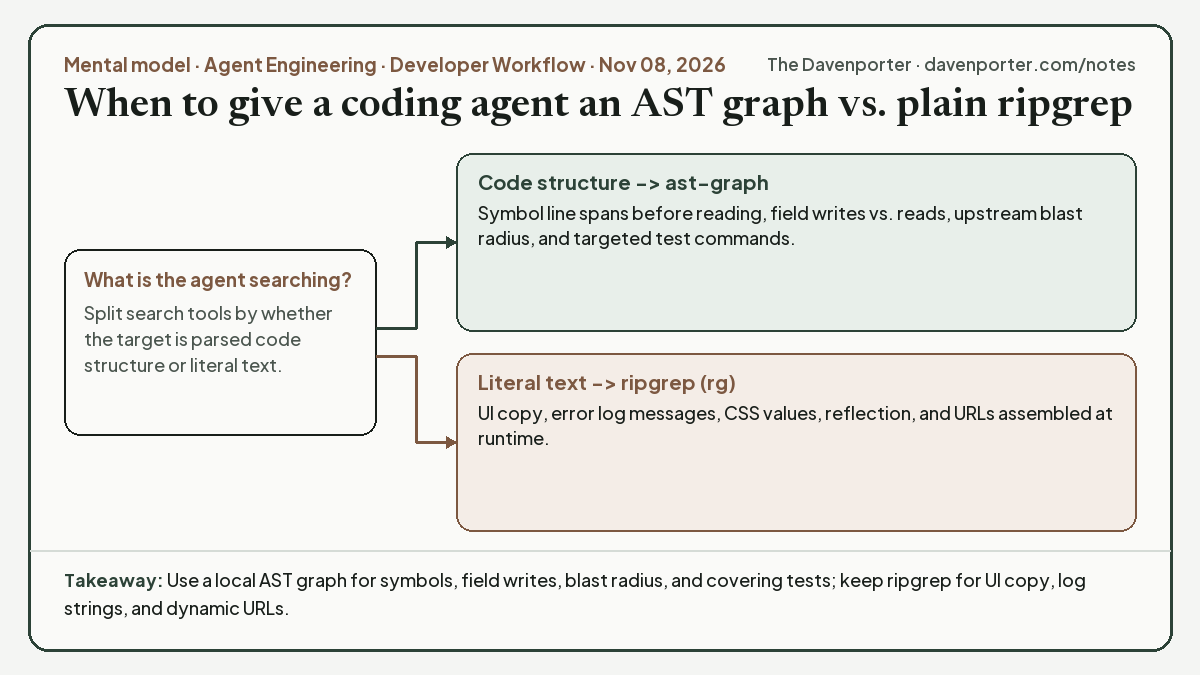
    When to give a coding agent an AST graph vs. plain ripgrep

    Takeaway

    Use a local AST graph for symbols, field writes, blast radius, and covering tests; keep ripgrep for UI copy, log strings, and dynamic URLs.

    Parallel two-branch diagram splitting agent code search between ast-graph for parsed structure and ripgrep for literal strings.
    Parallel two-branch diagram splitting agent code search between ast-graph for parsed structure and ripgrep for literal strings.
    Read context and raw numbers

    Static symbol indexing cuts 70% to 90% of structural search tokens across my sessions, while rg remains the right tool whenever the target is a raw string rather than a symbol.

    What is the agent searching? Split search tools by whether the target is parsed code structure or literal text.

    Code structure -> ast-graph - Exact file#Lstart-Lend spans before reading a 3,000-line file - Property writes separated from reads for state bugs - Upstream blast radius and targeted test commands

    Literal text -> ripgrep (rg) - UI copy, error messages, and CSS values - Dynamic imports, reflection, and URLs built at runtime

    Full essay: Your coding agent is reading too much code → Build: ast-graph →
  5. Nov 06, 2026
    Scorecard Agent Engineering · Developer Tools
    #

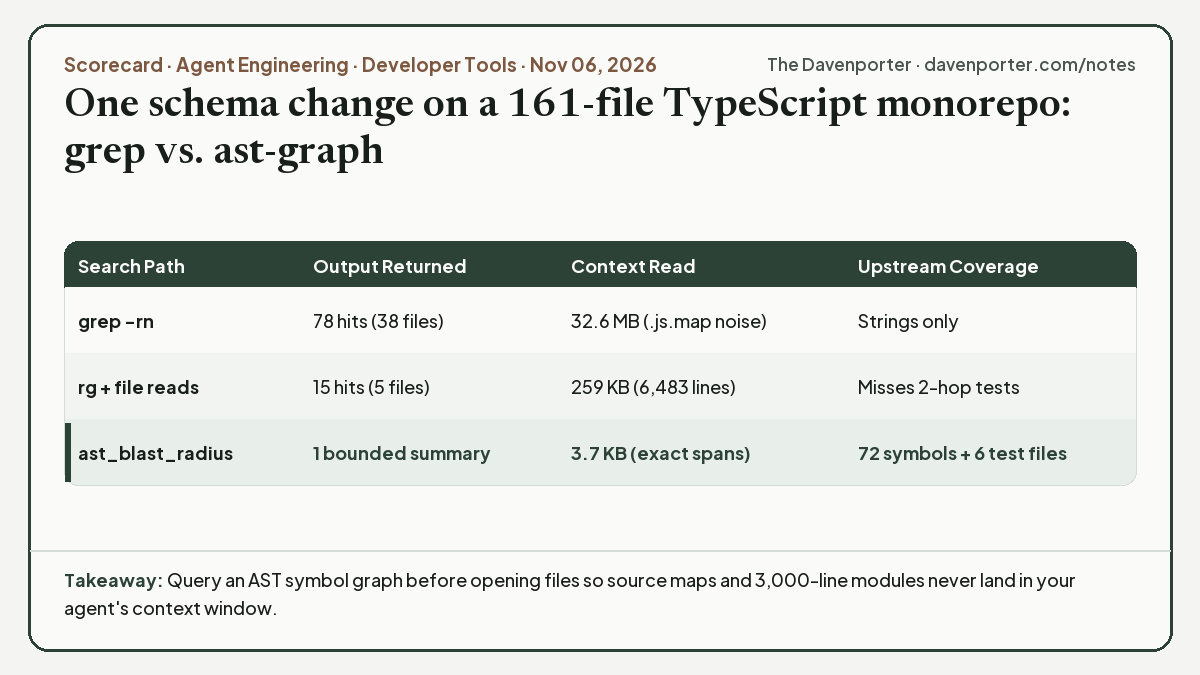
    One schema change on a 161-file TypeScript monorepo: grep vs. ast-graph

    Takeaway

    Query an AST symbol graph before opening files so source maps and 3,000-line modules never land in your agent's context window.

    Scorecard comparing grep, ripgrep, and ast-graph blast radius on a 161-file TypeScript monorepo.
    Scorecard comparing grep, ripgrep, and ast-graph blast radius on a 161-file TypeScript monorepo.
    Read context and raw numbers

    Changing JoinRequestSchema in FreightFloor's shared protocol package showed why string search gets expensive fast on real monorepos.

    Search PathOutput ReturnedContext ReadUpstream Coverage
    grep -rn78 hits (38 files)32.6 MB (.js.map noise)Strings only
    rg + file reads15 hits (5 files)259 KB (6,483 lines)Misses 2-hop tests
    ast_blast_radius1 bounded summary3.7 KB (exact spans)72 symbols + 6 test files

    The cheapest token in an agent loop is the file it never has to open.

    Full essay: Your coding agent is reading too much code → Build: ast-graph →
From workbench note to full essay

Scroll →

How daily workbench notes graduate into canonical essays Real benchmark tables, prompt diffs, and routing splits start as short workbench notes, get shared on LinkedIn and X, and the questions that spark discussion become full essays. 1. Capture • Benchmark scorecards • Before / after diffs • Routing mental models 2. Share nugget Timeline + native cards • Published at /notes • Native PNG on X & LI 3. Graduate Full canonical essay /notes.md · /api/notes /writings/{slug}
Short workbench artifacts land here first (and as Markdown at /notes.md or JSON at /api/notes); the notes that spark real engineering questions graduate into full essays.
Workbench notes index, newest first
Date Format Note Takeaway
Nov 18, 2026 Scorecard Gemini followed my UI skills and Opus skipped them: deleting 95% of my agent rules Guardrails written for older models poison newer ones that actually follow them: cutting 95% of my agent config (222.3 KB to 11.4 KB) fixed my UI builds.
Nov 17, 2026 Mental model Two coding agents, two worktrees: Floor Trials goes from 6 to 18 challenges, plus ghost runs Split parallel agent work by file ownership, tell each agent what the other one owns, and make every branch prove itself (bit-for-bit replays, a bot that clears each level) before merge.
Nov 10, 2026 Before / After Stop paying a generative model to print JSON just to pick another model Swapping a rubric-and-JSON classifier prompt for a single forward-pass decision call cut routing latency 3.5x (752 ms to 212 ms) with zero output tokens.
Nov 08, 2026 Mental model When to give a coding agent an AST graph vs. plain ripgrep Use a local AST graph for symbols, field writes, blast radius, and covering tests; keep ripgrep for UI copy, log strings, and dynamic URLs.
Nov 06, 2026 Scorecard One schema change on a 161-file TypeScript monorepo: grep vs. ast-graph Query an AST symbol graph before opening files so source maps and 3,000-line modules never land in your agent's context window.
About · Notes · Subscribe on Substack · RSS · Privacy ·
Ask

Social card and structured data

The share image, feeds and Schema.org JSON-LD that search engines and AI tools read for this page.

Social card

Title card for Notes
Card URL: /og/notes.svg

Machine feeds

/llms.txt /llms-full.txt /sitemap.xml /api/agent/spec

Structured data

{
  "@context": "https://schema.org",
  "@graph": [
    {
      "@type": "Person",
      "@id": "https://davenporter.com/#jason-davenport",
      "name": "Jason Davenport",
      "alternateName": "@davenportjw",
      "jobTitle": "AI & Distributed Systems Architect",
      "description": "Exploring agent-first source control (cosm), trajectory-to-lineage observability, Spanner-backed agent memory consolidation (Electric Sheep), hybrid local/cloud LLM routing, and real-time multiplayer browser simulations on Google Cloud Run.",
      "url": "https://davenporter.com",
      "sameAs": [
        "https://davenporter.substack.com",
        "https://www.linkedin.com/in/davenportjw",
        "https://github.com/davenportjw",
        "https://x.com/davenportjw",
        "https://medium.com/@davenportjw"
      ]
    },
    {
      "@type": "WebSite",
      "@id": "https://davenporter.com/#website",
      "url": "https://davenporter.com",
      "name": "The Davenporter",
      "description": "Learnings about software, technology, agentic systems, and occasionally home renovation.",
      "publisher": {
        "@id": "https://davenporter.com/#jason-davenport"
      },
      "inLanguage": "en-US"
    },
    {
      "@type": "ImageObject",
      "@id": "https://davenporter.com/notes#primaryimage",
      "url": "https://davenporter.com/og/notes.png",
      "contentUrl": "https://davenporter.com/og/notes.png",
      "width": 1200,
      "height": 630,
      "caption": "Title card for Notes",
      "representativeOfPage": true,
      "creator": {
        "@id": "https://davenporter.com/#jason-davenport"
      },
      "license": "https://creativecommons.org/licenses/by/4.0/",
      "acquireLicensePage": "https://davenporter.com/writings"
    },
    {
      "@type": "CollectionPage",
      "@id": "https://davenporter.com/notes#webpage",
      "url": "https://davenporter.com/notes",
      "name": "Notes | The Davenporter",
      "description": "I keep short workbench notes here between full essays: benchmark scorecards, before and after diffs, and two-branch routing diagrams from real agent builds, each paired with a plain takeaway you can test on your own traffic.",
      "isPartOf": {
        "@id": "https://davenporter.com/#website"
      },
      "about": {
        "@id": "https://davenporter.com/#jason-davenport"
      },
      "primaryImageOfPage": {
        "@id": "https://davenporter.com/notes#primaryimage"
      },
      "inLanguage": "en-US"
    },
    {
      "@type": "FAQPage",
      "@id": "https://davenporter.com/notes#faq",
      "mainEntity": [
        {
          "@type": "Question",
          "name": "What short workbench notes and benchmarks has Jason Davenport shared recently?",
          "acceptedAnswer": {
            "@type": "Answer",
            "text": "I keep short workbench notes here between full essays: benchmark scorecards, before and after diffs, and two-branch routing diagrams from real agent builds, each paired with a plain takeaway you can test on your own traffic."
          }
        }
      ]
    },
    {
      "@type": "BreadcrumbList",
      "@id": "https://davenporter.com/notes#breadcrumb",
      "itemListElement": [
        {
          "@type": "ListItem",
          "position": 1,
          "name": "Home",
          "item": "https://davenporter.com/"
        },
        {
          "@type": "ListItem",
          "position": 2,
          "name": "Notes",
          "item": "https://davenporter.com/notes"
        }
      ]
    }
  ]
}

Ask The Davenporter

Ask anything about the essays and builds on this site.